


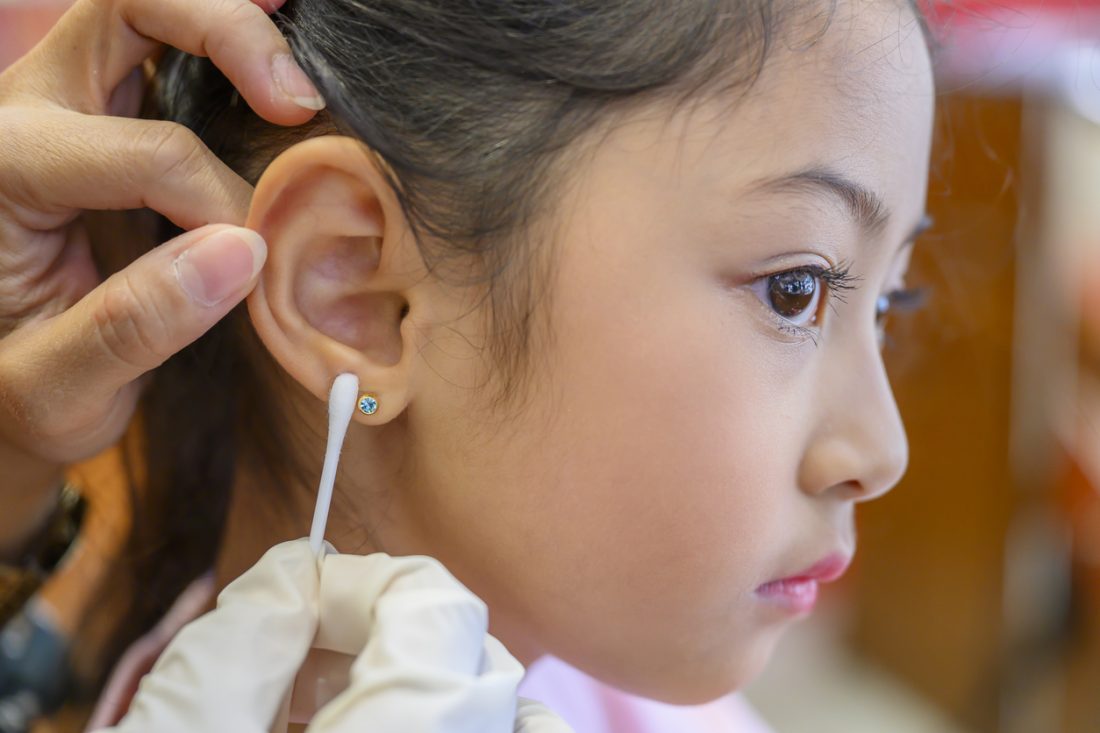
Ear Piercing – Tips from a Pediatrician
I remember being SO eager to have my ears pierced as a kid! I begged my mom to take me and wore clip-on or stick-on earrings for years in the meantime. After lots of negotiation about when top pierce my ears, we settled on piercing after my 5th grade graduation.
When my own child started asking about ear piercing, I realized why my parents had waited to let me do it.
When is the best time to pierce your child’s ears?
My own daughter started asking for ear piercing around age 4, but I knew it wasn’t the “right” time for her. Some days, even getting clothes on or hair brushed after a bath resulted in meltdowns; I couldn’t imagine trying to add cleaning piercing sites to the mix.
We decided together that it was the right time when she was around age 7 and could successfully help care for the piercings. It was a better experience for her than it would’ve been if we’d “given in” at age 4 when she wasn’t ready for all it required. We hadn’t done it when she was an infant because I felt like it was important for her to take part in the decision. However, some families have cultural traditions that include piercing young babies’ ears, and other families choose to do so because they find caring for piercings easiest at that age. In general, who should get their ears pierced and when to do so is a personal decision for each family.
Like with any “elective procedure,” it’s important to consider the risks and benefits. As a pediatrician, I recommend families wait on ear piercing until babies are at least 4-6 months old so they’ve received multiple sets of their routine vaccines, including the Hepatitis B series (usually completed at their 6-month well-child visit). Jewelry choice is important in addition. Infant earrings should have locking or screw-style backs to reduce the chance of them pulling it out and swallowing it. Consider also that hoop earrings can lead to torn ear lobes if a baby or child grabs and pulls at it.
What do I need to know about piercing my child’s ears?
Regardless of the age of your child, finding a trained piercing professional who uses sterile equipment is essential for the best outcome. Some doctors’ offices offer ear piercings. I took my child to a tattoo and piercing parlor recommended by other pediatricians, and we had an excellent experience there. Key questions to consider when choosing where to go include:
- How do they sterilize their equipment?
- What type of piercing do they do (gun or needle)?
- What is the piercing professional’s training/experience?
Proper care of piercing sites (anywhere on the body) is exceptionally important. I think of it like a wound after having surgery; if you don’t care for it, complications can occur. Talk with your piercing professional about their care recommendations; typically, the main routine is to clean the site daily with sterile saline or a specific gentle cleanser. Jewelry should not be changed out until the piercing has FULLY healed (or epithelialized, where the outer skin cells line the piercing), which may take several months. And be sure to check the piercings every day – even when they have healed up – to make sure the backs stay loose. Young kids sometimes don’t notice when the backs have become too tight – and this can cause the earring to get embedded or stuck in the earlobe.
Your piercing professional will let you know the typical timeline for healing and if any follow up is recommended. My daughter’s piercings took almost 5 months to fully heal – a long time for an impatient kiddo! I was glad we did the piercing in the spring, as we knew she needed to be able to remove the earrings to play in her fall soccer games. Now, as an 8-year-old self-identified “fashionista,” she happily chooses earrings to match her outfit each morning – and has already forgotten about those years her earlobes were disappointingly bare!
Resources for Parents
The Academy of Pediatrics


Featured Author
 Dr. Lindsay Frost's biography reads: I joined the pediatrics team at Kaiser Permanente South Sacramento in 2018 to help kids thrive. During my medical training, I pursued a Masters degree in public health and health promotion. I enjoy being able to foster long-term relationships with patients and their families, providing care in both health and illness as children grow. Some of my most relevant experiences as a pediatrician have come from my two children, who have “trained” me first-hand on the challenges of parenthood.
Read more at https://mydoctor.kaiserpermanente.org/ncal/providers/lindsayfrost
Dr. Lindsay Frost's biography reads: I joined the pediatrics team at Kaiser Permanente South Sacramento in 2018 to help kids thrive. During my medical training, I pursued a Masters degree in public health and health promotion. I enjoy being able to foster long-term relationships with patients and their families, providing care in both health and illness as children grow. Some of my most relevant experiences as a pediatrician have come from my two children, who have “trained” me first-hand on the challenges of parenthood.
Read more at https://mydoctor.kaiserpermanente.org/ncal/providers/lindsayfrost Disclaimer: If you have an emergency medical condition, call 911 or go to the nearest hospital. An emergency medical condition is any of the following: (1) a medical condition that manifests itself by acute symptoms of sufficient severity (including severe pain) such that you could reasonably expect the absence of immediate medical attention to result in serious jeopardy to your health or body functions or organs; (2) active labor when there isn't enough time for safe transfer to a Plan hospital (or designated hospital) before delivery, or if transfer poses a threat to your (or your unborn child's) health and safety, or (3) a mental disorder that manifests itself by acute symptoms of sufficient severity such that either you are an immediate danger to yourself or others, or you are not immediately able to provide for, or use, food, shelter, or clothing, due to the mental disorder. This information is not intended to diagnose health problems or to take the place of specific medical advice or care you receive from your physician or other health care professional. If you have persistent health problems, or if you have additional questions, please consult with your doctor. If you have questions or need more information about your medication, please speak to your pharmacist. Kaiser Permanente does not endorse the medications or products mentioned. Any trade names listed are for easy identification only.