


Are E-Bikes and E-Scooters Safe for Kids? A Pediatrician’s Guide
Recently, I walked into an office visit with a 12-year-old patient. His appointment request said he was there for a “skin abrasion.” Expecting a skinned knee or similar, I was shocked to see him sitting uncomfortably on the exam table with open, weeping wounds on his palms, shoulder, hips, and knees.
When I asked what happened, he reported, “I fell off my scooter.” I looked at his mom, and she clarified, “It was an e-scooter.” As his story went, a fly flew into his face while he was casually riding the e-scooter, and as he tried to swat it away, the scooter accelerated and he skidded on the pavement at a high velocity. Thankfully he had no major bony or brain injuries, but he was clearly in pain and devastated he wouldn’t be able to play in a basketball game that night with wounds on his palms.
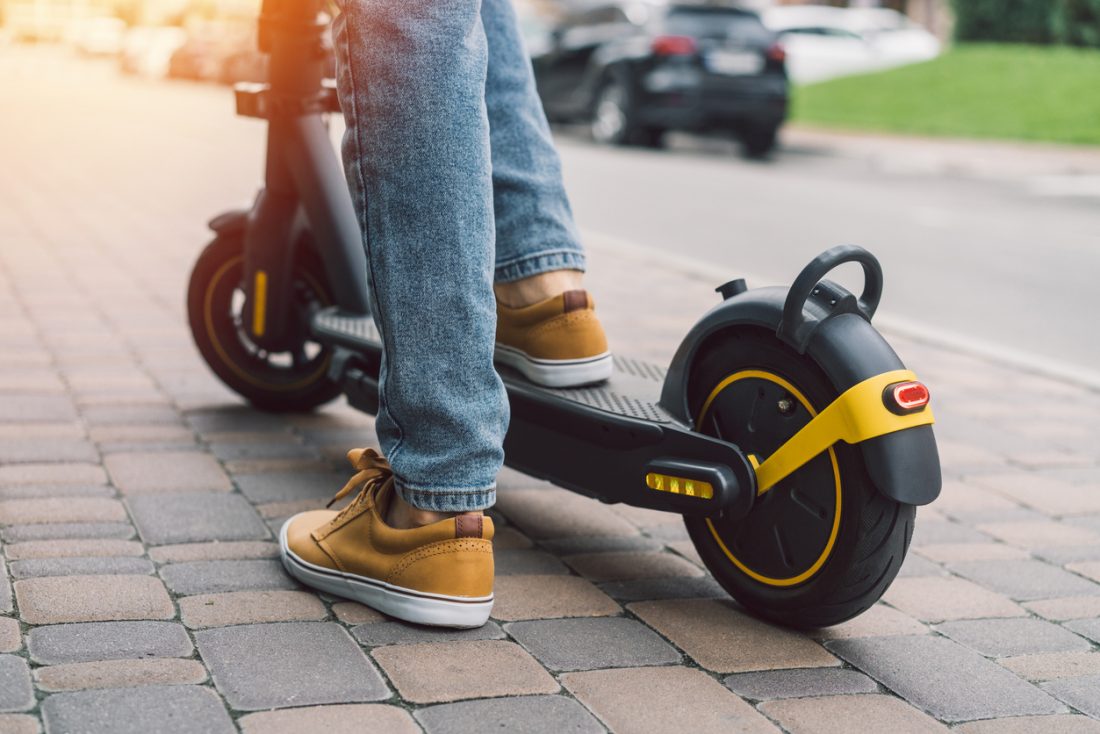
What are e-scooters and e-bikes?
Electric-powered bikes and scooters (known as “e-bikes” and “e-scooters”, or “Micromobility” devices) have been increasing in popularity over the past decade. An e-scooter is a fully motorized device that is not human-powered and does not have pedals. An e-bike has pedals and the option to be fully human-powered or to have motorized assistance. Class 1 and Class 2 e-bikes can go up to 20 miles per hour, while Class 3 can go up to 28 miles per hour.
What are their risks?
As the popularity of both e-scooters and e-bikes has grown, there has been an increase in related injuries, especially among youth. While biking and scootering are generally great ways for kids to get outdoors, move their bodies, transport themselves to school or activities, and socialize with friends, the motorized versions of these devices dramatically heighten the risk of injuries.
E-scooters and e-bikes accelerate quickly, and many people ride them at high speeds on shared paths with pedal bikes and pedestrians (although this is not permitted in some cities). Injuries on e-bikes and e-scooters are more severe than on non-motorized ones largely due to the high speeds they can reach without as much physical effort by the rider. High-speed crashes are more common on e-bikes, leading to injuries such as facial fractures and concussions among youth riders.
I wince each time I see young kids in my community riding them – especially without helmets. While helmets don’t provide 100% protection, they can significantly reduce the severity of a life-threatening head injury and various facial injuries.
What are the rules about riding Micromobility devices?
Out of curiosity, I looked up my city’s rules regarding e-bike and e-scooter use and found that regulations differ between states and cities. Find the rules for your city and state here.
I was surprised to find that in my state of California, e-scooter riders are legally required to have a learner’s permit or driver’s license, and this is true in many other states. Class 3 e-bikes also have a legal minimum age of 16 in California (14 to 16 in other states) for similar safety reasons.
How can I decide if my child is ready for for an e-bike or e-scooter?
If your family is considering an e-bike or e-scooter for your child, I’d recommend using this American Academy of Pediatrics checklist: Is Your Child Ready for an E-Bike? It takes into account your child’s age, skill level, and willingness to abide by all local regulations, including making safe decisions and always wearing their helmet.
My own pre-teen is asking for an e-scooter because many of his friends ride them. It’s hard as a parent to hold my ground on a safety topic I feel strongly about when “everybody has them.” For now, he knows our family’s answer is no, but as he approaches age 16 we might reconsider with the above checklist above in mind. One small parenting win for the time being – each time he sees me watch someone helmet-less, speeding down the sidewalk on an e-scooter, he reassures me he WILL wear his helmet if he ever gets one.
Resources for Parents
Centers for Disease Control
CDC HEADS UP Helmet Safety
US Consumer Product Safety Commission
Micromobility: E-Bikes, E-Scooters and Hoverboards


Featured Author
 I joined the pediatrics team at Kaiser Permanente South Sacramento to help kids thrive. A professional interest of mine is to support breastfeeding families as an International Board Certified Lactation Consultant (IBCLC). During my medical training, I also pursued a degree in public health/health promotion - a field which applies to every patient visit in pediatrics. Yet, some of my most relevant experiences as a pediatrician has come from my two children, who have “trained” me first-hand on the challenges of parenthood and in finding the balance between evidence-based recommendations and reality to achieve optimal childhood growth and development. Dr. Frost's full biography can be found on My Doctor Online.
Disclaimer: If you have an emergency medical condition, call 911 or go to the nearest hospital. An emergency medical condition is any of the following: (1) a medical condition that manifests itself by acute symptoms of sufficient severity (including severe pain) such that you could reasonably expect the absence of immediate medical attention to result in serious jeopardy to your health or body functions or organs; (2) active labor when there isn't enough time for safe transfer to a Plan hospital (or designated hospital) before delivery, or if transfer poses a threat to your (or your unborn child's) health and safety, or (3) a mental disorder that manifests itself by acute symptoms of sufficient severity such that either you are an immediate danger to yourself or others, or you are not immediately able to provide for, or use, food, shelter, or clothing, due to the mental disorder. This information is not intended to diagnose health problems or to take the place of specific medical advice or care you receive from your physician or other health care professional. If you have persistent health problems, or if you have additional questions, please consult with your doctor. If you have questions or need more information about your medication, please speak to your pharmacist. Kaiser Permanente does not endorse the medications or products mentioned. Any trade names listed are for easy identification only.