


Reading From The Start
The best part of most days in the office for me? Well, that’s a tough choice between choosing stickers with kids after their appointments and giving them books to take home! That’s right: we give every child 6 months to 5 years a book at each well-child visit. And while the stickers are just pure fun, the books have a purpose beyond making kids smile.
We know the more books a parent reads to them, the more words a young child learns.
Studies show that kids who get lots of books, songs, and conversations from parents each day have a much more extensive vocabulary than those who don’t.
Sometimes busy parents tell me it’s hard to find time to read. After raising three kids, I understand. Reading is definitely important, but on busy days when it feels hard, you can fit in some of the same benefits. I encourage parents to “sportscast their day” to their little ones. It can go something like this: “Look at the cat!” “What does the cat say?” “That’s right! Cats say ‘Meow!'” “Bye-bye, kitty! Meow!” You might sound silly, but – your child learns as you go.
Singing also helps kids learn words. Well, not when I sing because they tend to cover their ears when I do that – but I’m sure they’ll learn when you sing!
So back to the books. Why do we hand one out at each visit? We’ve partnered with Reach Out and Read, a national organization that champions the positive effects of reading daily with young children. Their website explains that there’s a critical window of time for all this learning:
“More than 80% of a child’s brain is formed during their first three years, and what they experience during this window can irreversibly affect how their brain develops. Attention and nurturing from a loving parent or caregiver supports healthy brain development – and one of the best ways to engage young children is to read books together.”
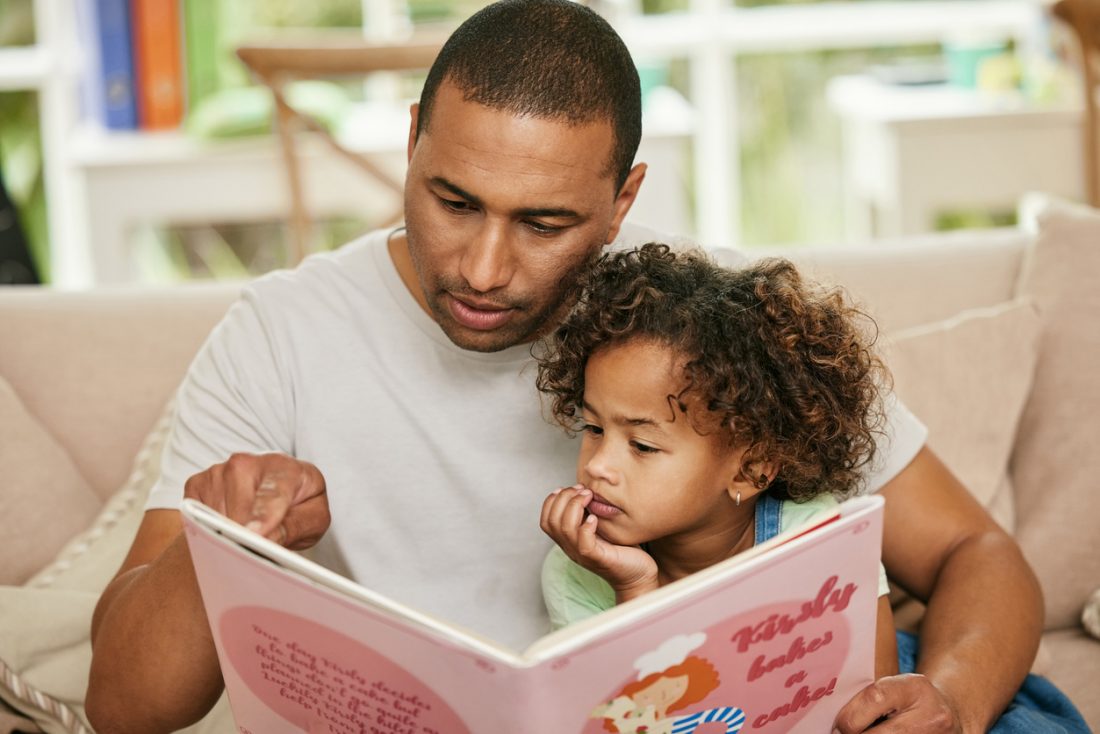
The American Academy of Pediatrics explains that both the quality and quantity of reading counts. High-quality reading has parents talking with their kids about the book and asking questions as they read. “What do you think will happen next?” “Look at the tree; who is hiding behind it?” “What do you think they are feeling?” Research has shown that:
“Reading quality and quantity of shared book-reading in early infancy and toddlerhood predicted child vocabulary up to four years later, prior to school entry. Book-reading quality during early infancy, in particular, predicted early reading skills while book-reading quantity and quality during toddler years appeared strongly tied to later emergent literacy skills, such as name-writing at age 4.”
Now, all that may feel intimidating, but start by just having fun! You don’t even have to read the book with the littlest ones- you can just talk about the pictures in it. That counts too!
Here are some tips for reading with young kids:
Make reading a routine. Maybe before bed, when your child first wakes up, or both. But whatever you choose, making reading a routine reinforces the habit.
Short and sweet is okay. Some kids won’t sit for long, and that’s okay. learn to sit still for longer as they grow, so just keep practicing.
Point at words as you read. Over time they’ll learn how to say them.
Let them control the pace. And let them turn the pages.
Let them choose the book. If your child is interested, it doesn’t matter what you read or look at together. You can read a storybook, comic book, magazine, or even a cereal box, and they will still learn!
Let them tell you the story. They may have memorized it, or they may be going off script and creating their own story. Either way is fine!
Ask them questions about the story. And let them ask you some too.
All the kids I see are thrilled to get a new book and usually want to start reading it immediately. But what do the 6-month-old babies do with their books? They stick ’em in their mouths and chew. Well, that’s a start! And that’s why those guys get the chunky books.
Resources For Parents:
Reach Out and Read
American Academy of Pediatrics


About the Author

Disclaimer: If you have an emergency medical condition, call 911 or go to the nearest hospital. An emergency medical condition is any of the following: (1) a medical condition that manifests itself by acute symptoms of sufficient severity (including severe pain) such that you could reasonably expect the absence of immediate medical attention to result in serious jeopardy to your health or body functions or organs; (2) active labor when there isn't enough time for safe transfer to a Plan hospital (or designated hospital) before delivery, or if transfer poses a threat to your (or your unborn child's) health and safety, or (3) a mental disorder that manifests itself by acute symptoms of sufficient severity such that either you are an immediate danger to yourself or others, or you are not immediately able to provide for, or use, food, shelter, or clothing, due to the mental disorder. This information is not intended to diagnose health problems or to take the place of specific medical advice or care you receive from your physician or other health care professional. If you have persistent health problems, or if you have additional questions, please consult with your doctor. If you have questions or need more information about your medication, please speak to your pharmacist. Kaiser Permanente does not endorse the medications or products mentioned. Any trade names listed are for easy identification only.