


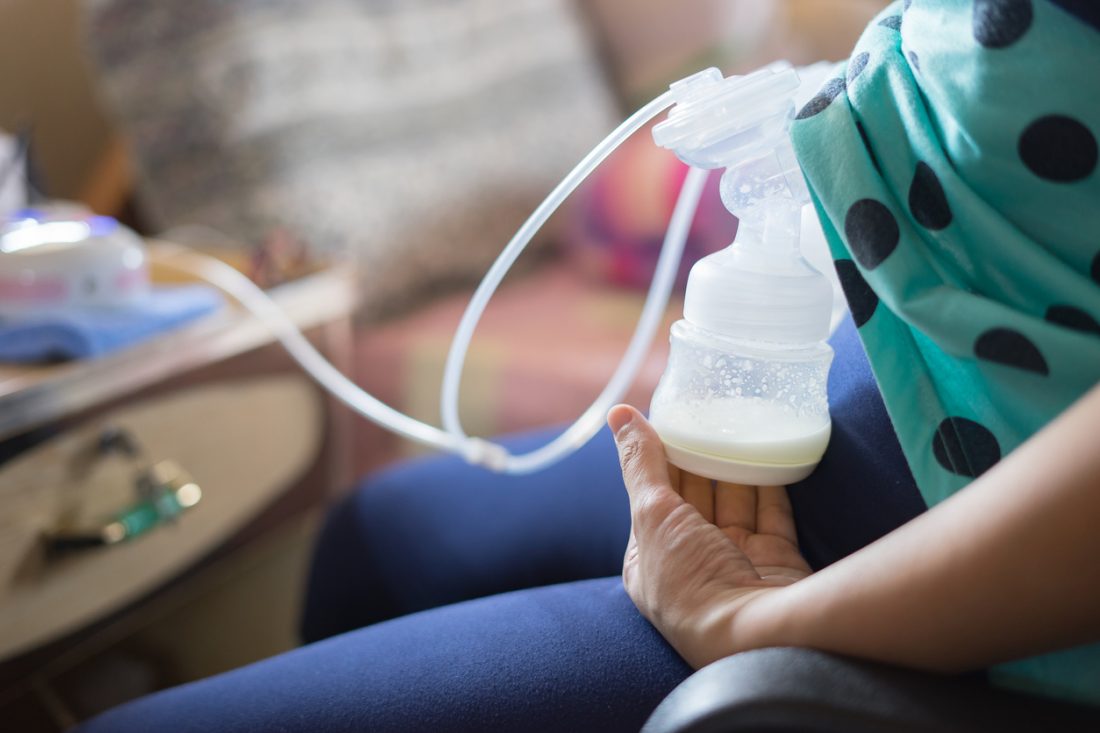
Adventures in Pumping
Our first child was born during the final year of my training to become a pediatrician. When he was around 2 months of age, we started practicing offering him pumped breast milk from a bottle. The first bottle was an epic failure – he clearly knew mom was home and still available to him!
On the second try, when he was starting to get hungry, I left 3 ounces of fresh-pumped breast milk with his dad and went for a walk on my own. Dad was so happy that the baby took 2 ounces, but I nearly cried when I poured the unused ounce of “liquid gold” down the drain and learned that you may have to waste an ounce here or there as you’re figuring these things out.
By the fourth or fifth try, we found our son’s preferences. He wanted to be rocked, with the milk warmed, in one specific type of bottle – with mom nowhere nearby. While it was hard to watch his bottle refusals initially, over time his needs for bottle-feeding became less particular, and my “mommy guilt” about leaving my infant settled.
My first day back from maternity leave started abruptly, with just an hour’s notice to cover a sick colleague’s overnight shift. I’d spent plenty of time planning how to provide breast milk for my baby but still went into panic mode that day. Leaving my baby at home overnight for the first time and pumping milk through the night felt unfathomable. But I knew many moms had done it before, and I could make it happen too!
Thankfully, my son slept peacefully and easily took bottles without me that first shift away. Meanwhile, my night was filled with admitting patients to the hospital and pumping whenever possible. Thankfully, a wise working mom friend had given me some tips for pumping and storing breastmilk at work:
Enjoy looking at photos or videos of your baby while pumping. Your baby is really cute! Seeing your cooing baby helps with milk letdown, shortens pumping time, and increases pumped volume. Aren’t our bodies amazing?
Keep it simple. And find a system that works for you. You can pour expressed milk throughout the day into a large water bottle and store this in the fridge to portion out later. Or just store your milk in the bottles you pump into. You may need to buy extra bottles and lids, but this can save you some time!
Extra pump parts save time. Invest in extra pump parts (flanges and valves) so you don’t have to wash them at each pump session. You may have heard of the “fridge hack” where you put your pump parts in the fridge and re-use them throughout the day without washing them. However, in 2017 the Centers for Disease Control and Prevention (CDC) recommended that pump parts be washed between every session to avoid dangerous bacteria growth. If you can’t wash them after each session, buy enough parts to last you until you can. Place the used ones in a Ziploc in the fridge, then wash them as soon as possible, and sterilize them.
Wash once. After work, soak all empty bottles and pump parts in hot soapy water, in a wash bin that you use only for cleaning pump parts – not in your sink, where bacteria may grow. You can also use the dishwasher. Air dry all parts completely. Don’t dry with a cloth.
Give yourself grace. It can be hard to set time aside for pump breaks during a workday. Some pump sessions may be rushed and short, and some days they may be less often than you’d hope. Even so, every session counts to care for your baby! It’s important to continue pumping as much as you can to keep your supply up and to prevent getting plugged ducts or mastitis.
Freeze small portions. When thawed, frozen milk needs to be used within 24 hours. If freezer bags are 6 oz full and your baby only uses 4 oz of that milk, then 2 oz of liquid gold goes to waste.
Eventually, I started feeling more confident. I learned to advocate for myself and the time I needed to pump at work. Of course, there were many blunders too – not realizing I had leaked breast milk onto my blouse, knocking milk onto a laptop, and running to an emergency mid-pump with my nursing bra barely covering what it was supposed to.
While providing breast milk for your baby is natural and the healthiest choice for your baby, it’s often not easy on you, especially if you return to work. Whether you’re breastfeeding, pumping, or formula feeding, providing love for your baby is the most important thing to support their growth and development into an amazing little human. And regardless of whether breast milk ends up being a part of that love when you’re back at work, know that your fellow moms are cheering you on.
Resources For Parents:
My Doctor Online
American Academy of Pediatrics


Featured Author
 Dr. Frost's biography reads: I joined the pediatrics team at Kaiser Permanente South Sacramento in 2018 to help kids thrive. Outpatient pediatrics is a unique and rewarding medical specialty. I enjoy being able to foster long-term relationships with patients and their families, providing care in both health and illness as children grow. I believe that it is important to truly partner in health care with patients and their families; this allows not only for the best possible care but also for me to continue to learn and grow as a pediatrician. A professional interest of mine is to support breastfeeding families as an International Board Certified Lactation Consultant (IBCLC). During my medical training, I also pursued a degree in public health/health promotion - a field which applies to every patient visit in pediatrics. Yet, some of my most relevant experiences as a pediatrician has come from my two children, who have “trained” me first-hand on the challenges of parenthood and in finding the balance between evidence-based recommendations and reality to achieve optimal childhood growth and development. Being part of Kaiser Permanente allows physicians and patients access to integrated care and resources that are not readily available with other health systems. Kaiser Permanente’s commitment to preventive care is also an important piece of my personal care philosophy. I am proud to be part of the team at South Sacramento and I look forward to getting to know you and your family.
Dr. Frost's full biography can be found on My Doctor Online.
Dr. Frost's biography reads: I joined the pediatrics team at Kaiser Permanente South Sacramento in 2018 to help kids thrive. Outpatient pediatrics is a unique and rewarding medical specialty. I enjoy being able to foster long-term relationships with patients and their families, providing care in both health and illness as children grow. I believe that it is important to truly partner in health care with patients and their families; this allows not only for the best possible care but also for me to continue to learn and grow as a pediatrician. A professional interest of mine is to support breastfeeding families as an International Board Certified Lactation Consultant (IBCLC). During my medical training, I also pursued a degree in public health/health promotion - a field which applies to every patient visit in pediatrics. Yet, some of my most relevant experiences as a pediatrician has come from my two children, who have “trained” me first-hand on the challenges of parenthood and in finding the balance between evidence-based recommendations and reality to achieve optimal childhood growth and development. Being part of Kaiser Permanente allows physicians and patients access to integrated care and resources that are not readily available with other health systems. Kaiser Permanente’s commitment to preventive care is also an important piece of my personal care philosophy. I am proud to be part of the team at South Sacramento and I look forward to getting to know you and your family.
Dr. Frost's full biography can be found on My Doctor Online. Disclaimer: If you have an emergency medical condition, call 911 or go to the nearest hospital. An emergency medical condition is any of the following: (1) a medical condition that manifests itself by acute symptoms of sufficient severity (including severe pain) such that you could reasonably expect the absence of immediate medical attention to result in serious jeopardy to your health or body functions or organs; (2) active labor when there isn't enough time for safe transfer to a Plan hospital (or designated hospital) before delivery, or if transfer poses a threat to your (or your unborn child's) health and safety, or (3) a mental disorder that manifests itself by acute symptoms of sufficient severity such that either you are an immediate danger to yourself or others, or you are not immediately able to provide for, or use, food, shelter, or clothing, due to the mental disorder. This information is not intended to diagnose health problems or to take the place of specific medical advice or care you receive from your physician or other health care professional. If you have persistent health problems, or if you have additional questions, please consult with your doctor. If you have questions or need more information about your medication, please speak to your pharmacist. Kaiser Permanente does not endorse the medications or products mentioned. Any trade names listed are for easy identification only.